Searching a print of the first light of the universe
Even if it has been emitted a few 380.000 years after the big bang, the astronomers think they are able to detect in the CMB some clues of events happened immediately after the initial explosion. Indeed, fluctuations of this young universe have been ?frozen? during the decoupling between matter and radiation. So through the observations of this print with more and more accurate instruments, the astronomers measure the CMB characteristics. One of these characteristics which constitutes a major stake of observational cosmology today is the the CMB polarization, i.e. the privileged orientation of the radiation components. According to the current cosmological models, the radiation polarization results from two distinct phenomena, and each one give birth to one kind of polarization: on the one hand density fluctuations, and on the other hand the print of gravitational waves amplified by inflation (named respectively E-modes and B-modes in analogy with the components of an electromagnetic wave). In the first case, fluctuations to be detected are about some millionth of degree. Instruments on board of a space mission (WMAP), on-board of a balloon (BOOMERANG) or installed on the ground, especially on the Antarctic (DASI), have already succeeded in detecting these E-modes and have confirmed the CMB polarization. In the second case, polarization to be measured corresponds to fluctuations 10 times lower, about some tenth of millionth of degrees. These perturbations would have been caused by the first gravitational waves - waves modifying space and time produced by the big bang explosion and predicted by the Relativity - amplified during the inflation epoch ? during this infinitesimal period, the universe increasingly rose which makes it possible to explain why the universe is so homogeneous at large scales, and why temperature of the CMB seems so uniform. The stake of this B-modes measurement, never yet detected and often considered as the Graal of modern observational cosmology, is to observe an inflation signature by directly measuring inflation energy and thus to know more about the very first time of the universe. It would be also the first measurement of the gravitational waves emitted during the Big Bang explosion. Furthermore, this is a unique way today to test the string theory which predicts the undetectability of the B-modes?
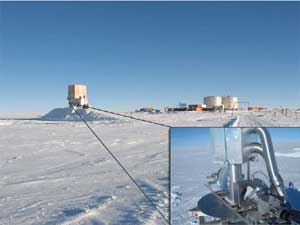 |
? BRAIN Collaboration
Near the Concordia station, the BRAIN pathfinder has been set up in 2006 in order to characterize precisely the instrumental constraints necessary to the project as well as the atmosphere quality to achieve CMB observations. The installation of the first BRAIN module out of nine is planned for 2010. |
 |
? E. Bondoux
The main goal of BRAIN is to measure the CMB polarization, and especially to detect some fluctuations of a few tenth of billionth of degrees, known as the B-modes. This detection will allow to know more on the first ages of the universe never observed by the astronomers, the inflation. |
Only 10% of the CMB is polarized and fluctuations to measure for a B-modes detection are 10 times fewer than E-modes ones. In this context, the track of B-modes constitutes a real instrumental prowess requiring an unprecedented control of systematic instrumental effects (alignment, polarization, detectors pointing and calibration, etc.) as well as atmospheric effects disturbing the measurements. To limit these constraints, the atmosphere must be particularly stable and cold, particularly transparent in the millimetre-wave and submillimiter-wave range, and must allow uninterrupted measurements over very long periods (several months). Dome C seems particularly favourable for this type of measurements: it is the object of the BRAIN project (B-mode RAdiation INterferometer). A pathfinder has been installed in 2006 to precisely characterize artefacts induced by the atmosphere and has already produced a month of data cumulated between January 2006 and January 2007 which confirm the potential of Dome C for this kind of measurements. BRAIN is a bolometric interferometer, i.e. an innovating instrument combining at the same time the advantages of interferometry in terms of systematic instrumental effects (perfectly polarized rays, atmospheric fluctuations rejection), as well as bolometer?s (very sensitive cryogenic detectors) in terms of sensitivity. To measure the CMB pollution due to the objects located in the foreground (our galaxy, our solar system and the Earth?s atmosphere) the final instrument will observe at 3 distinct frequencies (90 GHz, 150 GHz, 220 GHz) and each one of these channels will be made of 3 modules. The first of these 9 modules is planned to be installed in 2010 and the complete installation is planned for 2011.
|






)
)