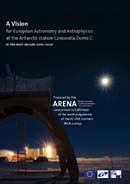
A frozen desert far from all sources of human pollution, located on the high plateau of the Antarctic continent, Dome C is a dream for astronomers. Its geography and meteorology combine to yield exceptional conditions for observing the sky.
LONG DURATION MONITORING OF VARIABLES OBJECTS
Some astrophysical phenomena are periodic, such as the transit of an extrasolar planet in front of its host star, or the oscillation modes with which stars vibrate. To study these variations, astronomers must be able to observe them as they repeat themselves, which requires uninterrupted observations over long periods of time.
LOOKING AT THE SKY THROUGH NEW SPECTRAL WINDOWS
The principal obstacle for astronomers is the Earth's atmosphere which has three main effects: it is absorbing, emissive and turbulent. This is why astronomers choose to set up their observatories on high mountains (such as Mauna Kea in Hawaii, or the Andes), send them aloft on planes or balloons, or even send them into space on rockets or satellites. Its high altitude (3000 to 4000m) and its cold and dry air give the antarctic plateau unique astronomical conditions, somewhere between space and the best currently-exploited sites on the ground.
MEASURING THE TINY FLUCTUATIONS OF THE UNIVERSE FIRST LIGHT
During these 20 last years, thanks to the new instruments sensitivity, cosmology science, that is to say the study of our universe history and its composition, truly entered an observational phase. Fundamental cosmological parameters such as baryonic matter density (ordinary matter), dark matter density (matter which do not interact with light and is revealed only by its mass), the part of dark energy, or even the age of the universe, can be measured with more and more of precision and it is now possible to test the validity of the existing models.