Most turbulence is concentrated in a few tens of meters
To measure the atmospheric stability, astronomers use two types of instruments: Balloon probes launched from the snow surface, with sensors measuring the temperature, pressure, humidity and wind speed; and telescopes on the ground with instruments to analyze the degradation of stellar images and thus deduce the characteristics of the atmosphere above Dome C. Since 2000, the Concordiastro programme (carried out by the Fizeau Laboratory, previously LUAN, and financed by IPEV) has undertaken several campaigns of measurements to characterise the atmosphere during the southern summer, i.e. daytime, which are crucial to future solar observations. Since the first winterover in 2005, astronomers have also been able to carry out night-time atmospheric measurements. According to these measurements, Dome C seems to be an exceptional site for astronomy. Its main feature is a "surface boundary layer", containing 80% of the turbulence. This would usually be spread out over the first 200 metres of atmosphere at the best astronomical sites, but at Dome C, the layer is only 30 metres thick! These unique conditions offer astronomers two ways to overcome atmospheric turbulence: By building a telescope above the boundary layer (the largest telescopes are currently installed more than 20 meters above the ground), or by using simplified Ground Layer Adaptive Optics (GLAO) which only have to correct for the effects of one thin layer of turbulent air.
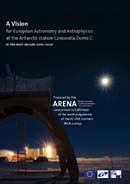
? E. Bondoux - Z. Chalita (2008) Dome C, February 2008: one can see the evidence of the optical turbulence effects produced by the boundary surface layer of nearly thirty meters on this moonrise picture. The lower edge is disturbed whereas the higher edge is regular.





)