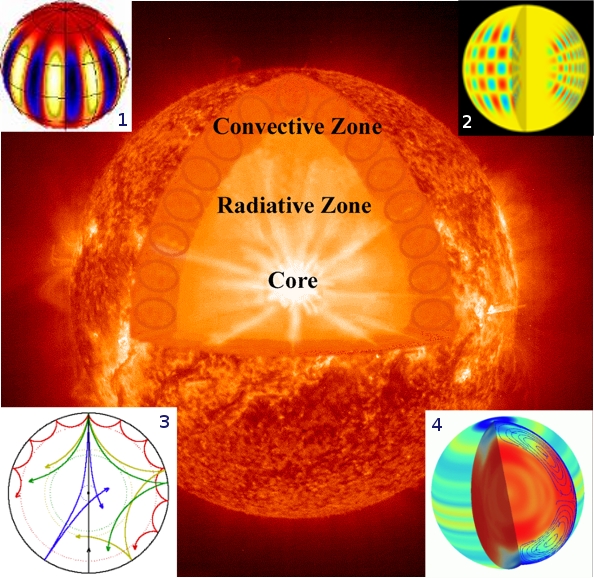
We only know the internal structure of the Earth by studying seismic waves and their propagation through our planet: Depending on their frequency, these waves penetrate more or less deeply into the Earth and their speed depends directly on the characteristics of the material which they are crossing. By precisely measuring these frequencies and speeds, it is possible to establish the internal structure of our planet, in terms of the pressure, temperature and density of the various layers. In the same way, astronomers probe the internal structure of stars by measuring the frequencies of the seismic waves propagating within them: this science is known as stellar seismology, or asteroseismology, and is done by measuring the stellar pulsations caused by the seismic waves ?rebounding? on the surface. In order to build a realistic seismic model of the star, it is necessary to measure many pulsation modes with different frequencies, penetrating more or less deeply into the star. However, some of these frequencies are very close to one another; in order to disentangle them, long uninterrupted observations are needed. The principal enemies of asteroseismologists are ?holes? in the data, so the quality of the data is largely determined by the ?duty cycle?: i.e. the proportion of data which is scientifically useful during a given period. This duty cycle depends on the day/night cycle, weather, and instrument maintenance. At Dome C, the duty cycle should reach nearly 90% during the 100 days of southern winter - an exceptional value, higher than the duty cycle of a 6-telescope network located around the world, taking turns throughout the same period.
? IMAGE - NASA
The stars Alpha Centauri and Beta Centauri are both particularly interesting targets for SIAMOIS; they are both solar type stars, and they are located near the Southern Cross, not far from the South Celestial Pole, they are thus observable continuously during a hundred days.
How are these frequencies measured? As it pulsates, the brightness of the star varies periodically. One technique is therefore simply to measure these brightness variations and determine their frequency precisely. To record many distinct frequencies, this ?photometric method? requires great precision in the stellar brightness measurement, which is most easily achieved from above the Earth's atmosphere, in space. The Corot space mission is designed to do this, and, even if the photometric characteristics of the sky are exceptional, Dome C is unlikely to be competitive with Corot. However, as the star pulsates, its size changes, so its surface moves. It is possible to use the Doppler effect to measure the speed of this movement. This is the ?spectrometric method?, which, compared to the photometric method, reduces the noise due to the granulation of the stellar surface and thus determines the structure more precisely. The asteroseismological potential of Dome C can be exploited by an instrument using the spectrometric method, proposed by several ARENA members: SIAMOIS (Seismic Interferometer Aiming to Measure Oscillations in the Interior of Stars) could have its first winterover in 2013. Located in a box behind a 40cm telescope dedicated solely to this program, SIAMOIS is a very cheap instrument, but is capable of producing scientific data to complement those from Corot, with an observing programme of about thirty solar-type stars. SIAMOIS could even be connected to several small telescopes in order to observe multiple stars simultaneously.
1 - This is by measuring precisely the stellar pulsations? frequencies that the asteroseismologists detect their oscillation modes. 2 ? Then they compare these modes with models. 3 - According to their frequency, these modes penetrate more or less deeply inside the star. 4 - By coupling the measurements with the models, the astronomers obtain maps of seismic waves propagation, giving them information on the internal stellar structures.




)